
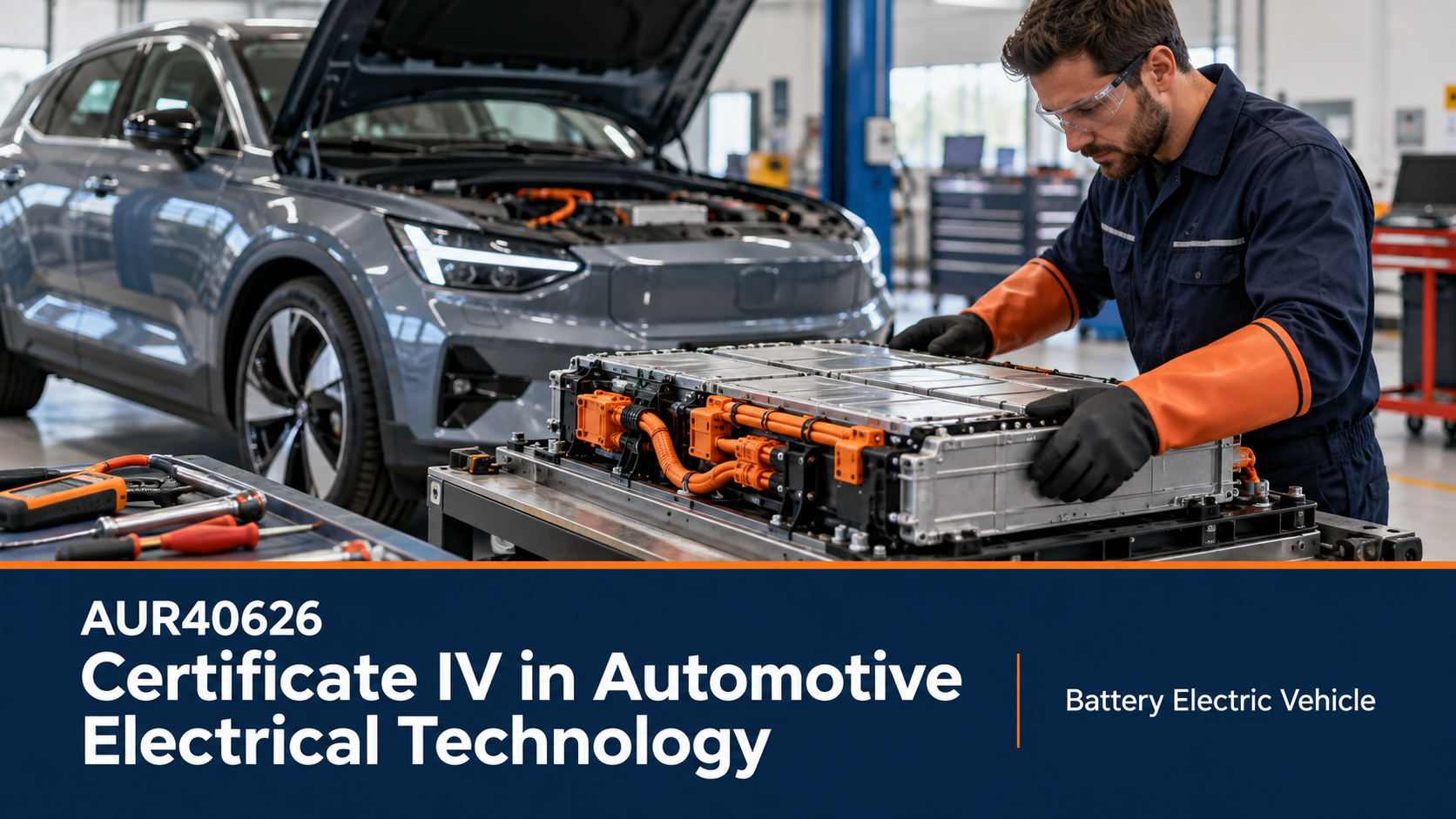
AUR40626
Certificate IV in Automotive Electrical Technology (Battery Electric Vehicle)
Develop advanced diagnostic skills in high-voltage batteries, traction motors, motor controls, electric braking and battery electric vehicle systems.
26 teaching weeks + 6 break weeks.
Delivery: Face-to-face automotive training; confirmed cohort timetable and attendance hours are supplied before enrolment.
Intakes: Confirm available monthly intakes with admissions.
Course overview
Develop advanced diagnostic skills in high-voltage batteries, traction motors, motor controls, electric braking and battery electric vehicle systems.
Automotive Electrical Master Diagnostic Technician; Battery Electric Vehicle Diagnostic Technician; Advanced Automotive Electrician; Electric Vehicle Technical Adviser; Workshop Team Leader. Successful completion leads to AUR40626 (Battery Electric Vehicle).
Skills, qualification outcome & pathways
Skills you will develop
- Safely depower and reinitialise battery electric vehicles.
- Diagnose high-voltage battery, traction motor, control and thermal-management faults covered by selected units.
- Interpret test data and document complex electrical diagnostic findings.
Completion outcome
After successfully completing the required assessments and issuance requirements, students receive AUR40626 Certificate IV in Automotive Electrical Technology (Battery Electric Vehicle).
Occupational and further-study pathways
Automotive Electrical Master Diagnostic Technician; Battery Electric Vehicle Diagnostic Technician; Advanced Automotive Electrician; Electric Vehicle Technical Adviser; Workshop Team Leader. Successful completion leads to AUR40626 (Battery Electric Vehicle).
Employment depends on prior experience, employer requirements and applicable licensing. Further-study admission and credit are assessed by the receiving provider. Completion does not guarantee a job, occupational licence or migration outcome.
Entry requirements & suitability
Domestic students
- Be at least 18 years of age when the course commences.
- Have completed Australian Year 11 or an overseas equivalent, or demonstrate equivalent knowledge and relevant industry experience.
- Hold a relevant Certificate III qualification where required by the training product or UTAIT’s approved Training and Assessment Strategy.
- Complete UTA Institute of Technology’s pre-training review and college pre-entry assessment.
- Have sufficient digital literacy and physical capacity to participate safely in classroom and automotive workshop activities.
International students
- Be at least 18 years of age when the course commences.
- Have completed Australian Year 11 or an overseas equivalent, or demonstrate equivalent knowledge and relevant industry experience.
- Hold a relevant Certificate III qualification where required by the training product or UTAIT’s approved Training and Assessment Strategy.
- Meet UTAIT’s approved English-language admission requirements and provide accepted evidence of English proficiency.
- Complete UTAIT’s pre-training review and college pre-entry assessment.
- Separately meet the Australian Government’s English-language and other eligibility requirements for a Student visa.
- Provide certified evidence of previous education and qualifications, with an approved English translation where required.
Recommended ACSF entry profile
| Core skill | Recommended entry level |
|---|---|
| Learning | ACSF Level 3 |
| Reading | ACSF Level 3 |
| Writing | ACSF Level 3 |
| Oral Communication | ACSF Level 3 |
| Numeracy | ACSF Level 3 |
UTAIT assesses language, literacy, numeracy and digital skills before enrolment to determine course suitability and identify any required learning support.
Important: The ACSF levels shown are UTAIT’s recommended entry profile and are not automatic requirements created by the AQF qualification level. Entry requirements must remain consistent with the relevant training product and UTAIT’s approved Training and Assessment Strategy. Any qualification-specific or unit prerequisites take precedence over these general requirements. Meeting Student visa English requirements does not automatically establish suitability for admission to a UTAIT course.
Fees & payment
All amounts are AUD. Total = tuition + materials + enrolment / administration.
| Student category | Tuition | Materials | Enrolment/admin | Total |
|---|---|---|---|---|
| Domestic | $4,650.00 | $850.00 | $350.00 | $5,850.00 |
| International onshore | $7,550.00 | $850.00 | $350.00 | $8,750.00 |
| International offshore | $7,550.00 | $850.00 | $350.00 | $8,750.00 |
2026–2027 non-bundled course fee schedule supplied by UTAIT.
Request the approved payment schedule and refund terms before enrolment. An enquiry does not reserve a place.
Units & learning content
10 units: 1 core + 9 electives
| Code | Unit | Type |
|---|---|---|
| AURTTA121 | Diagnose complex system faults | Core |
| AURETH101 | Depower and reinitialise battery electric vehicles | Elective |
| AURETH102 | Inspect and maintain battery electric vehicles | Elective |
| AURETH103 | Diagnose and repair high voltage rechargeable energy storage systems in battery electric vehicles | Elective |
| AURETH104 | Diagnose and repair traction motor speed control systems in battery electric vehicles | Elective |
| AURETH105 | Diagnose and repair high voltage traction motors in battery electric vehicles | Elective |
| AURETH108 | Diagnose and repair HVAC and rechargeable energy storage cooling systems in battery electric vehicles | Elective |
| AURETH109 | Diagnose and repair DC-to-DC converters in battery electric vehicles | Elective |
| AURETB101 | Diagnose and repair electric braking systems | Elective |
| AURETH016 | Diagnose and repair complex faults in battery electric vehicle powertrains | Elective |
Recognition & next steps
Prior learning and credit transfer may be assessed individually. Successful completion is subject to meeting all assessment requirements.
No employment, licensing, visa or migration outcome is guaranteed. Where occupational licensing applies, confirm eligibility with the relevant regulator.
Explore RPL and credit transfer →