
AUR32126
Certificate III in Automotive Body Repair Technology
Develop practical skills in repairing vehicle bodies, replacing panels and working safely with contemporary automotive materials.
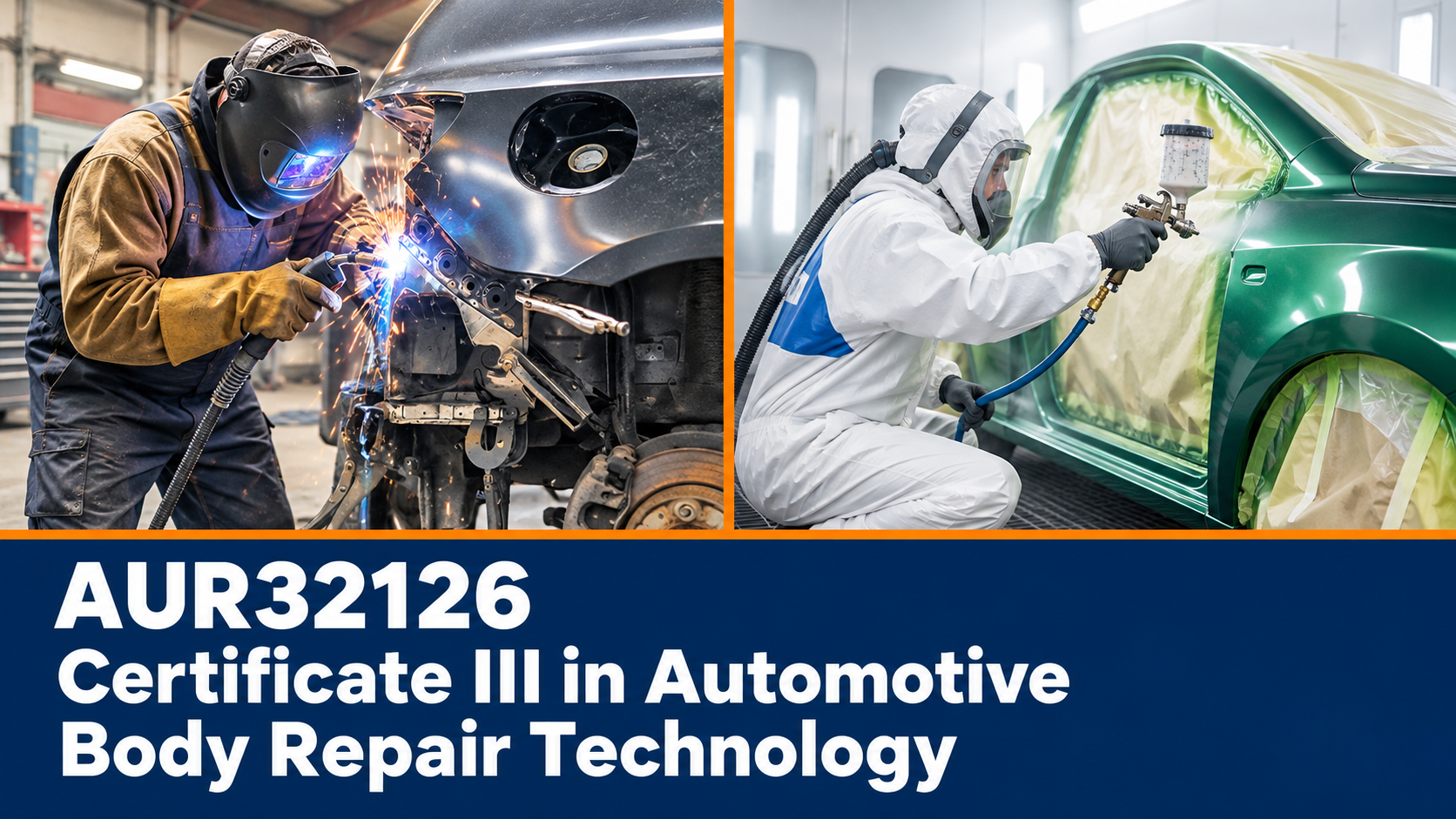
52 teaching weeks + 10 break weeks.
Delivery: Face-to-face automotive training; confirmed cohort timetable and attendance hours are supplied before enrolment.
Intakes: Confirm available monthly intakes with admissions.
Course overview
This qualification develops automotive body-repair skills for cars and other vehicles in the service and repair industry. The approved training plan contains 31 units: 17 core and 14 electives.
Successful completion leads to AUR32126 Certificate III in Automotive Body Repair Technology. A Statement of Attainment may be issued for successfully completed units when the full qualification is not completed, subject to assessment and issuance requirements.
Skills, qualification outcome & pathways
Skills you will develop
- Inspect collision damage and select appropriate repair procedures.
- Repair and replace body panels and structural sections using the selected welding and joining methods.
- Apply manufacturer repair instructions, restore alignment and document repair work.
Completion outcome
After successfully completing the required assessments and issuance requirements, students receive AUR32126 Certificate III in Automotive Body Repair Technology.
Occupational and further-study pathways
Develop skills relevant to automotive body repair roles.
Employment depends on prior experience, employer requirements and applicable licensing. Further-study admission and credit are assessed by the receiving provider. Completion does not guarantee a job, occupational licence or migration outcome.
Entry requirements & suitability
Domestic students
- Be at least 18 years of age when the course commences.
- Have completed Australian Year 10 or an overseas equivalent, or demonstrate equivalent knowledge and relevant experience.
- Meet any qualification-specific prerequisites.
- Complete UTA Institute of Technology’s pre-training review and college pre-entry assessment.
- Have sufficient digital literacy and physical capacity to participate safely in classroom and automotive workshop activities.
International students
- Be at least 18 years of age when the course commences.
- Have completed Australian Year 10 or an overseas equivalent, or demonstrate equivalent knowledge and relevant experience.
- Meet any qualification-specific prerequisites.
- Meet UTAIT’s approved English-language admission requirements and provide accepted evidence of English proficiency.
- Complete UTAIT’s pre-training review and college pre-entry assessment.
- Separately meet the Australian Government’s English-language and other eligibility requirements for a Student visa.
- Provide certified evidence of previous education and qualifications, with an approved English translation where required.
Recommended ACSF entry profile
| Core skill | Recommended entry level |
|---|---|
| Learning | ACSF Level 3 |
| Reading | ACSF Level 3 |
| Writing | ACSF Level 2 |
| Oral Communication | ACSF Level 3 |
| Numeracy | ACSF Level 2 |
UTAIT assesses language, literacy, numeracy and digital skills before enrolment to determine course suitability and identify any required learning support.
Important: The ACSF levels shown are UTAIT’s recommended entry profile and are not automatic requirements created by the AQF qualification level. Entry requirements must remain consistent with the relevant training product and UTAIT’s approved Training and Assessment Strategy. Any qualification-specific or unit prerequisites take precedence over these general requirements. Meeting Student visa English requirements does not automatically establish suitability for admission to a UTAIT course.
Fees & payment
All amounts are AUD. Total = tuition + materials + enrolment / administration.
| Student category | Tuition | Materials | Enrolment/admin | Total |
|---|---|---|---|---|
| Domestic | $15,000.00 | $850.00 | $350.00 | $16,200.00 |
| International onshore | $17,500.00 | $850.00 | $350.00 | $18,700.00 |
| International offshore | $17,800.00 | $850.00 | $350.00 | $19,000.00 |
2026–2027 non-bundled course fee schedule supplied by UTAIT.
Request the approved payment schedule and refund terms before enrolment. An enquiry does not reserve a place.
Units & learning content
31 units: 17 core + 14 electives
| Code | Unit | Type |
|---|---|---|
| AURAFA108 | Interpret and apply automotive repair instructions | Published selection |
| AURAEA002 | Follow environmental and sustainability best practices in an automotive workplace | Published selection |
| AURASA102 | Follow safe working practices in an automotive workplace | Published selection |
| AURETR042 | Remove, refit and operate electrical components following body repair activities | Published selection |
| AURETR125 | Test, charge and replace batteries and jump-start vehicles | Published selection |
| AURTTK102 | Use and maintain tools and equipment in an automotive workplace | Published selection |
| AURTTY001 | Repair vehicle chassis, frame and associated components | Published selection |
| AURVTN003 | Remove and store vehicle body components | Published selection |
| AURVTN022 | Repair vehicle body misalignment | Published selection |
| AURVTN104 | Remove, replace and align bolt-on vehicle body panels and components | Published selection |
| AURVTN116 | Repair vehicle body panels using filler | Published selection |
| AURVTN220 | Remove and replace major welded panels on vehicles | Published selection |
| AURVTN123 | Repair adhesive bonded structural damage on vehicles | Published selection |
| AURVTN132 | Inspect vehicle damage and determine repair procedures | Published selection |
| AURVTN135 | Apply original equipment manufacturer repair procedures during vehicle repairs | Published selection |
| AURVTW103 | Carry out advanced gas metal arc welding on vehicle body sections | Published selection |
| AURVTW105 | Carry out spot welding | Published selection |
| AURVTN102 | Carry out non-structural vehicle panel repairs | Published selection |
| AURVTW007 | Carry out oxyacetylene thermal heating and cutting on vehicle body sections | Published selection |
| AURVTN115 | Repair vehicle body panels using metal finishing | Published selection |
| AURVTN017 | Repair vehicle thermoplastic body panels and components | Published selection |
| AURVTN018 | Repair and replace vehicle structural damage | Published selection |
| AURVTN126 | Repair vehicle aluminium body panels without the use of body filler | Published selection |
| AURVTN127 | Repair vehicle aluminium body panels using filler | Published selection |
| AURVTN031 | Carry out sectional vehicle repairs | Published selection |
| AURVTA002 | Remove and replace vehicle supplementary restraint systems | Published selection |
| AURVTW104 | Carry out tungsten inert gas welding | Published selection |
| AURVTN119 | Repair vehicle structural damage by riveting | Published selection |
| AURVTN006 | Remove and replace mechanical units during vehicle repair | Published selection |
| AURVTP005 | Apply rust prevention and sound deadening materials to vehicle body components | Published selection |
| AURAMA001 | Work effectively with others in an automotive workplace | Published selection |
Recognition & next steps
Prior learning and credit transfer may be assessed individually. Successful completion is subject to meeting all assessment requirements.
No employment, licensing, visa or migration outcome is guaranteed. Where occupational licensing applies, confirm eligibility with the relevant regulator.
Explore RPL and credit transfer →